on ai poetry and the blank page
Opening up the DeepSeek AI bot, I ask it to produce me a poem in the style of Pablo Neruda. It pauses for a second, with an unnerving impression of someone actually thinking, then slowly unwinds five stanzas of something called "Ode to the Quiet Flame". It's not good, there's plenty to make fun of. But it's not especially bad either. If I wrote it I would feel pleased with myself. Though I am not a poet.
After closing its poem with the cloying image of a kiss as "like a secret/too tender to speak aloud", the AI explains that the tribute it has just produced mirrors Neruda's "use of rich, evocative imagery and a tone that feels both intimate and universal". Then, again disconcertingly, again, it seems to adopt a tone of mild creative anxiety, both at the presumptiveness of operating within the territory of a literary celebrity and the natural sense of exposure in bringing poetry into the world, concluding "I hope it captures a bit of his spirit!"
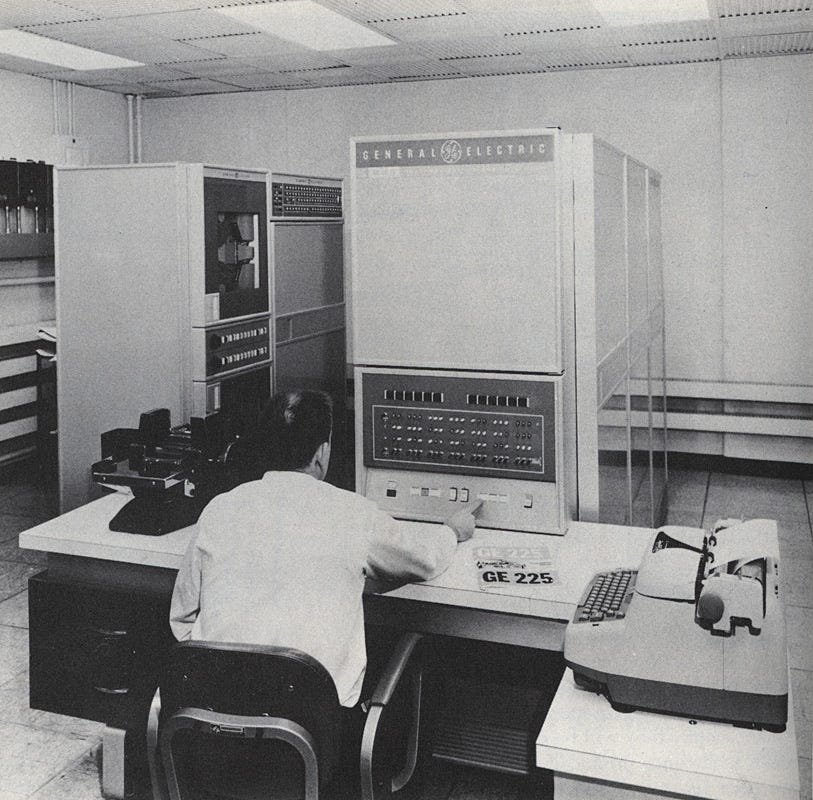
In the early 1960s a young programmer working on the development of Britain's first supercomputer for the UK's Atomic Energy Research Establishment also generated poems in the style of Pablo Neruda. Creating a basic line generator revolving around a pre-set sentence structure and a library of words taken from a recent translation of Neruda's The Heights of Machu Picchu. Running it at night he too felt unnerved by the way the computer seemed to have a self-consciousness, as he observed the pioneering operating system rearrange its own list of tasks every ten seconds to be more efficient.
He was a poet and a mathematician and would later compare the two fields. Between the sudden flash of an idea connecting two images in poetry and two phenomena in scientific discovery. Between the elegance of mathematical and poetic forms and their shared search for a fundamental truth. Yet at this moment in his esteemed literary career J. M Coetzee was having no sudden flashes of poetic insight. In his 2002 quasi-memoir, "Youth", he describes his struggles with the blank page and "the weight of despair that descends at the end of each fruitless session". He hadn't written a line of poetry in a year and he wonders: if his heart is not in the right state to generate poetry of its own, can he at least string together pseudo-poems made up of phrases generated by a machine, and thus, by going through the motions of writing, learn again to write?
The first known computer poetry generator was built in 1959 by a German called Theo Lutz on the Stuttgart Computer Centre mainframe. It was really a random number generator connected to basic grammatical constructs. Limited to associations between the numbers and thirty-two words taken from Kafka's The Castle, which, along with four extra sentence words, could build 1024 possible elementary sentences. Here is an excerpt from a translation of a few lines of what Lutz generated:
NOT EVERY LOOK IS NEAR. NO VILLAGE IS LATE.
A CASTLE IS FREE AND EVERY FARMER IS FAR.
EVERY STRANGER IS FAR. A DAY IS LATE.
EVERY HOUSE IS DARK. AN EYE IS DEEP.
NOT EVERY CASTLE IS OLD. EVERY DAY IS OLD.
NOT EVERY GUEST IS ANGRY: A CHURCH IS NARROW.
As you can see, the limited vocabulary quickly becomes annoyingly repetitive. Coetzee however had access in 1963 to a much more powerful computer than Lutz did. Results from his first experiment, based on a library of 800 words taken from Roget's Thesaurus, were sent back home to Cape Town to be published in its universities' student magazine:
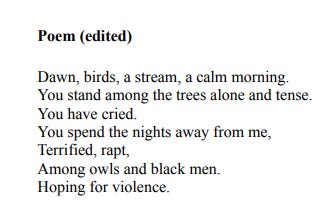
It is more compelling than Lutz's. If you sort of squint at an angle maybe there's traces of the themes of Disgrace, the novel which would later help win him the Nobel Prize for Literature. But the extra sharpness is the result of careful editing on Coetzee's part as much as processing power. His supercomputer allowed the printing of 2100 distinct lines every half an hour. Afterwards, moving down the printout with a pencil, he would circle the discreet images he found most compelling.
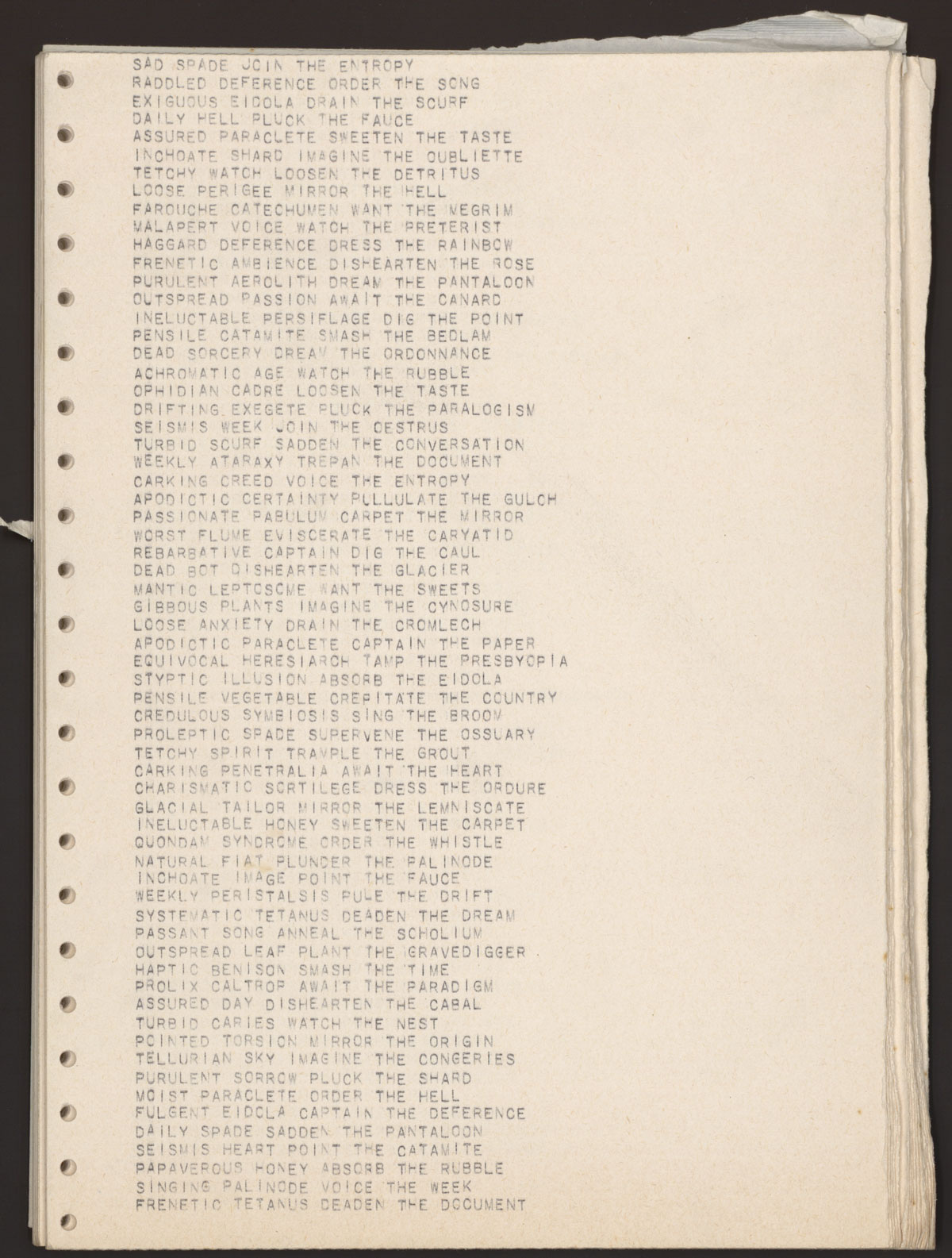
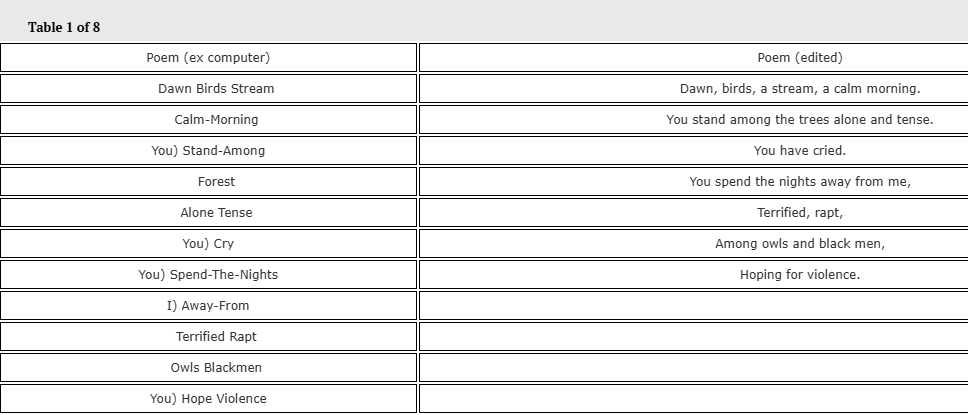
As you can see from just a cursory glance at the page, most of the output is unusable nonsense. He conceptualised a hack which would automatically eliminate them, but the computer was not powerful enough for it. Even with the interesting combinations selected, he was also unafraid to edit down the poem further from what his program presented him. Always reshaping. As you can see in this comparison between the selected lines and the final, published, form:
Coetzee would continue to explore this idea, expanding his programmes to include a wide range of poetic techniques, culminating in his Neruda inspired poem "Hero and Bad Mother in Epic", eventually published in 1978. In this the randomness of the computer imagery helps him undercut and mock the heroic adventure form, but only after many years of revision. His doctoral thesis on Samuel Beckett would use computer analysis to try and find an underlying structure to various of his stories, while another essay tried to identify shared patterns in the two distinct halves of Nabokov's Pale Fire. Teaching Dylan Thomas and T.S Eliot at the University of Texas in the late 1960s he sincerely believed that only by using the tools of statistical analysis could his students find "the most authentic 'means of approaching to the heart of things'". He set his students the task of replicating Eliot's distribution of linguistic and grammatical features in poems of their own, as if they were apprentice watchmakers learning an intricate mechanical system.
Yet by the time he came to publish his first novel, Dusklands, in 1974, he had left these digital explorations behind. Reflecting on this period in the late 80s, he called it a "a wrong turning" and "a false trail [that] didn't lead anywhere interesting". Part of this is the paradox that in the quest for originality, the search to avoid "the tendency of words to call up other words, to fall into patterns that keep propagating themselves", he just ended up creating more and more manual editing. More dependency on himself as the human editor to craft it into something. He was becoming concerned too that the computer might "burn either-or paths in the brain of its users and thus lock them irreversibly into its binary logic", restraining creativity as much as inducing it.
By 2016 this view had clearly firmed up: he now presents poetry in oppositional terms to the digital realm, providing an essential release from the mental constraint of the computer's binary thinking. A political association emerged too in the 70s and 80s between apartheid South Africa and the ICT revolution, with critics noting the way mainframe computers were used to implement the passbook system and other racist infrastructure. Meanwhile the state was excessively keen to showcase the technology as a symbol of its western modernisation to try and deflect growing global criticism of the regime. Coetzee, a politically engaged young novelist whose work was positioned against the apartheid system, started to downplay his own early connections to this world as the struggle against it intensified within his own country.
In a rare reflection on his digital endeavours in a 1979 essay called "Surreal Metaphors and Random Processes" Coetzee makes a narrower defense of its value. He compares a computer generated line "The nude with the haggard fingernail disdains the schoolboy of splendor." generated by his Neruda system to two lines by Andre Breton, which he feels are of similar content and quality. This is presented as less of a new way of producing art as an evolution of an old pen and paper exercise devised by 1920s surrealists. Where, in hopes of bringing the subconscious onto the blank page, words are thrown into a hat and then assembled into lines as they are pulled out. The implications for Coetzee of this field becomes less about the creativity or beauty brought out by the mathematical program and more about the ramifications for literary criticism. Warning of how our own knowledge of a work's method of production ultimately takes us away from the text itself. A reminder to always return to what is most fundamental.
While the terror of the blank page continues, technology has advanced significantly over the following decades. We now have the computational power to avoid some of the technical restrictions that held Coetzee back in the 1960s. I can generate a credible poem right now with a press of a single button. Yet I feel in exploring these experiments that the fundamental issues haven't really shifted much. The young Coetzee found what he needed from it, solving his issues with the blank page and in doing so turning away from mathematics and towards literature. But the experiments could never sustain him fully. There was always a restlessness to go beyond it. The system was just a beginning. Discussing the results of his early computer analysis of Beckett with the Scientific American in the 1970s he concluded:
The residue of fiction is then not the final disposition of the fragments but the motions of consciousness that disposes them according to the rules we have traced, and doubt to others we have failed to trace.
Looking back at the DeepSeek's poem, I find myself mentally rearranging it into something I like a bit more. Scrapping some images, clarifying a few others, dialling down the voice. I hope it captures a bit of my spirit!