on antony gormley's "6 times" and climate anxiety
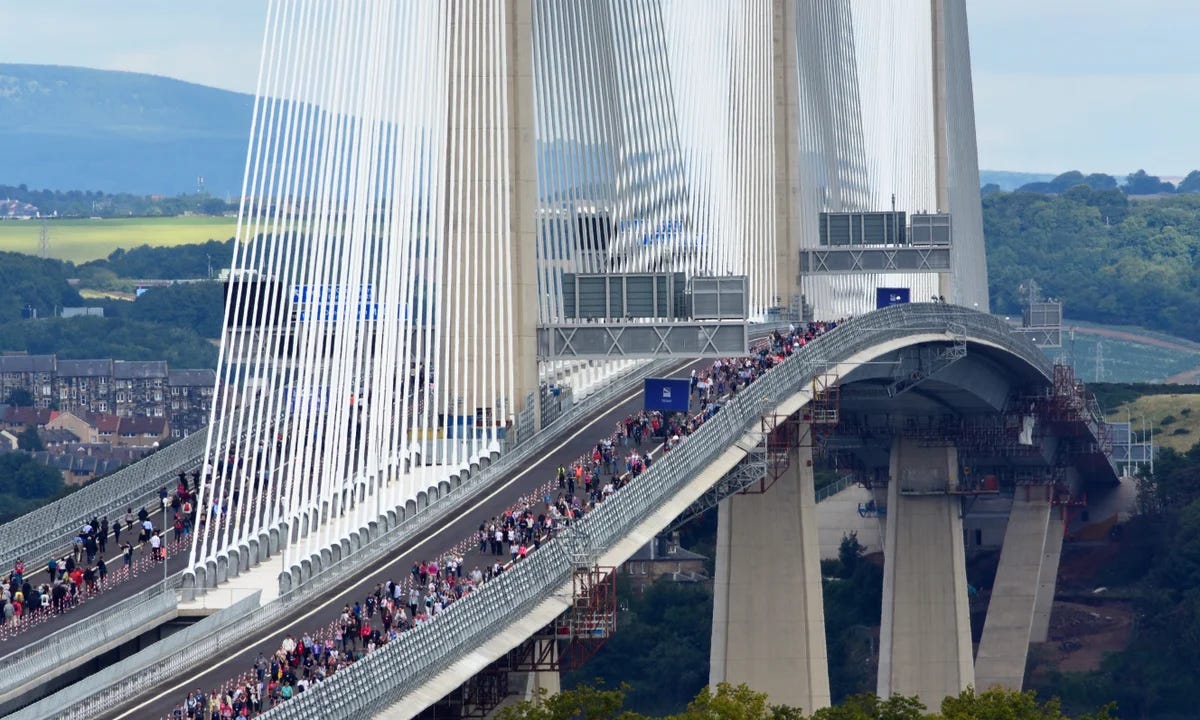
In his book “Footprints: In Search of Future Fossils”, investigating mankind's impact on our planet through its surviving traces in the distant future, David Farrier describes walking across the vast new Queensferry Crossing bridge in 2017, days before its first opening to traffic. Looking out over the Firth of Forth, he imagines the effects of deep time on the bridge’s 35,000 tons of steel and 23,000km of cabling.
One million years from now, the bridge’s thin towers, its choir of shining cables and elegantly curving deck, will be long gone. The surface of the road will be washed away. But even as the eroding forces of weather and time take their toll, grinding down the cliff and filling the engineers’ clefts with sediment, the concrete foundation and the rock cutting will still be legible, written into the earth like speech marks around a lost quotation, bearing witness that here, once upon a time, a road crossed a river that will itself long since have vanished.
Deep time is a concern too for the sculptor Antony Gormley. One of only a handful of contemporary UK artists whose names wouldn’t turn up as a single digit score on Pointless. In an interview in 2002, he talked about his work as a “communication between human beings and deep time and deep space”, comparing the way it “speaks of our vulnerability in time” to the figures on Easter Island. He returns regularly in other interviews to the notion of sculptures' distinct ability to “inscribe in geological time” human feeling and thought, and seeing his work acting as “industrial fossils”.
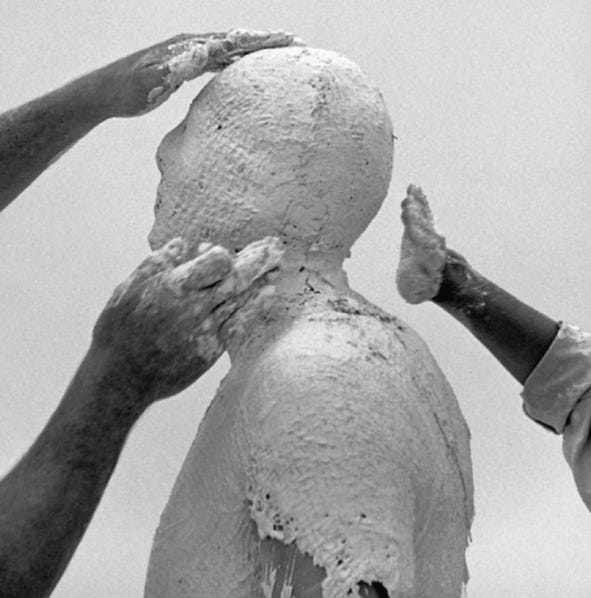
The figure that recurs most in his work is that of a cast iron statue of himself. In his studio he strips naked, his body is wrapped by an assistant in clingfilm and then covered with wet plaster. He remains standing in a single position, inevitably slightly different each time, until it dries, at which point he is cut out of the cast using saws. Hopefully, carefully. In a later work where he would attempt to recreate a whole small community in a field through this same process, one participant describes fainting three times. In his early career he would cover the mould of himself with sheets of soldered lead, leaving a hollow interior, but now he fills the cast built from the mould with iron, ultimately weighing three quarters of a ton. In conversation with the novelist Ian McEwan in 2006 he describes this particular material in deep time terms as “the most potent element, it's the thing that makes the red in our blood. It's the thing that keeps the whole jolly planet on its course in space”.
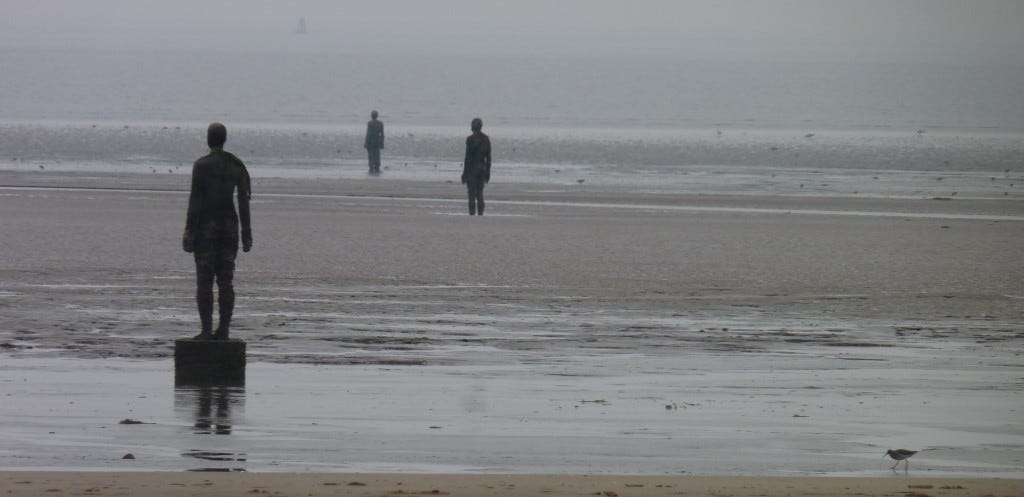
Keen to take art out of the specialised gallery and into a place where they can be altered by their environment, these cast iron figures have then found their way, individually, or in groups, across the world. They are seen in a disused factory on the outskirts of Shanghai, in a former prison in Charleston, South Carolina, next to a ruined amphitheatre on the island of Delos, staring at the concrete walls of an underground road system in Norway, and most famously, scattered on the beach in Crosby, just outside Liverpool, all gazing out to the sea.
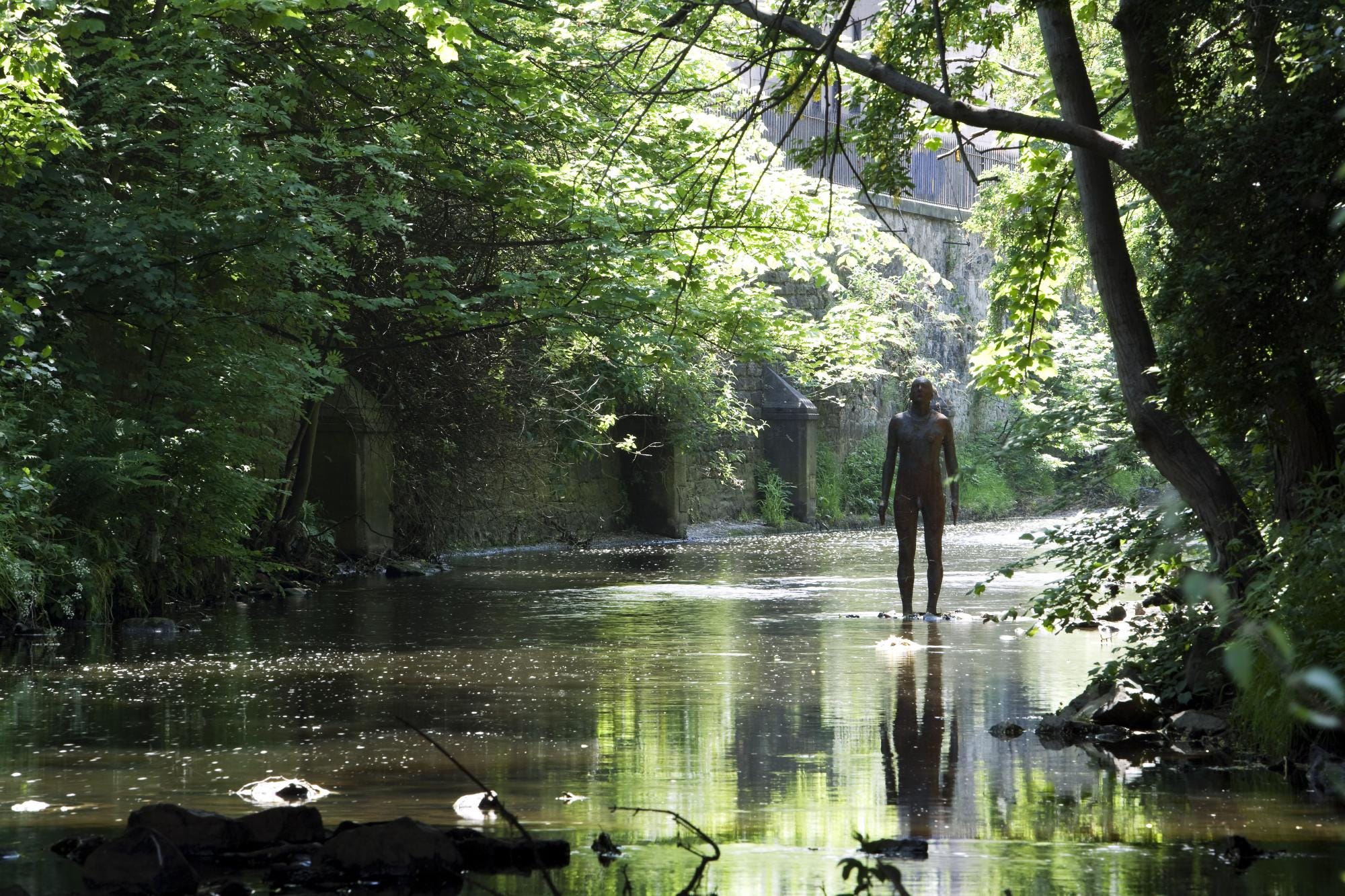
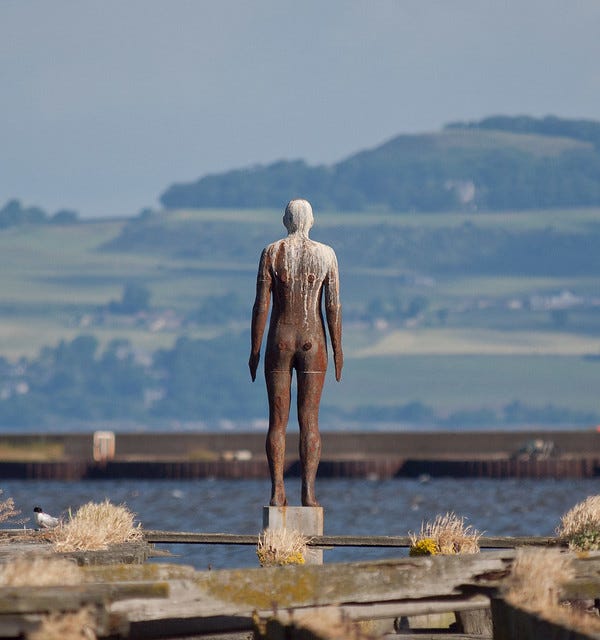
There are six of these statues here in Edinburgh. The work is called “6 Times”, though I only ever refer to them myself as “the Gormley’s”. They were erected in 2010 and within a week someone had waded into the river to dress one in a bright pink bikini. On another’s return from repairs in 2019 it would shortly be provided with its own pair of men’s boxers. The Scottish Modern National Gallery, who commissioned them, invites its visitors to follow the trail of them along the Water of Leith path cutting through the north of the city. The first is positioned emerging halfway out of the pavement by the gallery and the final one gazing out at the sea, and perhaps the promise of possibility, at the end of a ruined wooden pier in the port of Leith. As if they are the romantic hero in Caspar David Friedrich’s Wanderer in the Sea of Fog. The page on the galleries website for 6 Times, in the jaunty tone of tourist trade copy, explains how on route you will find “plenty of places to quench your thirst and rest your weary feet. There are great pubs and restaurants, including must-try seafood!” and welcomes you to pass through Dean Village as it is “a favourite among Instagrammers”.
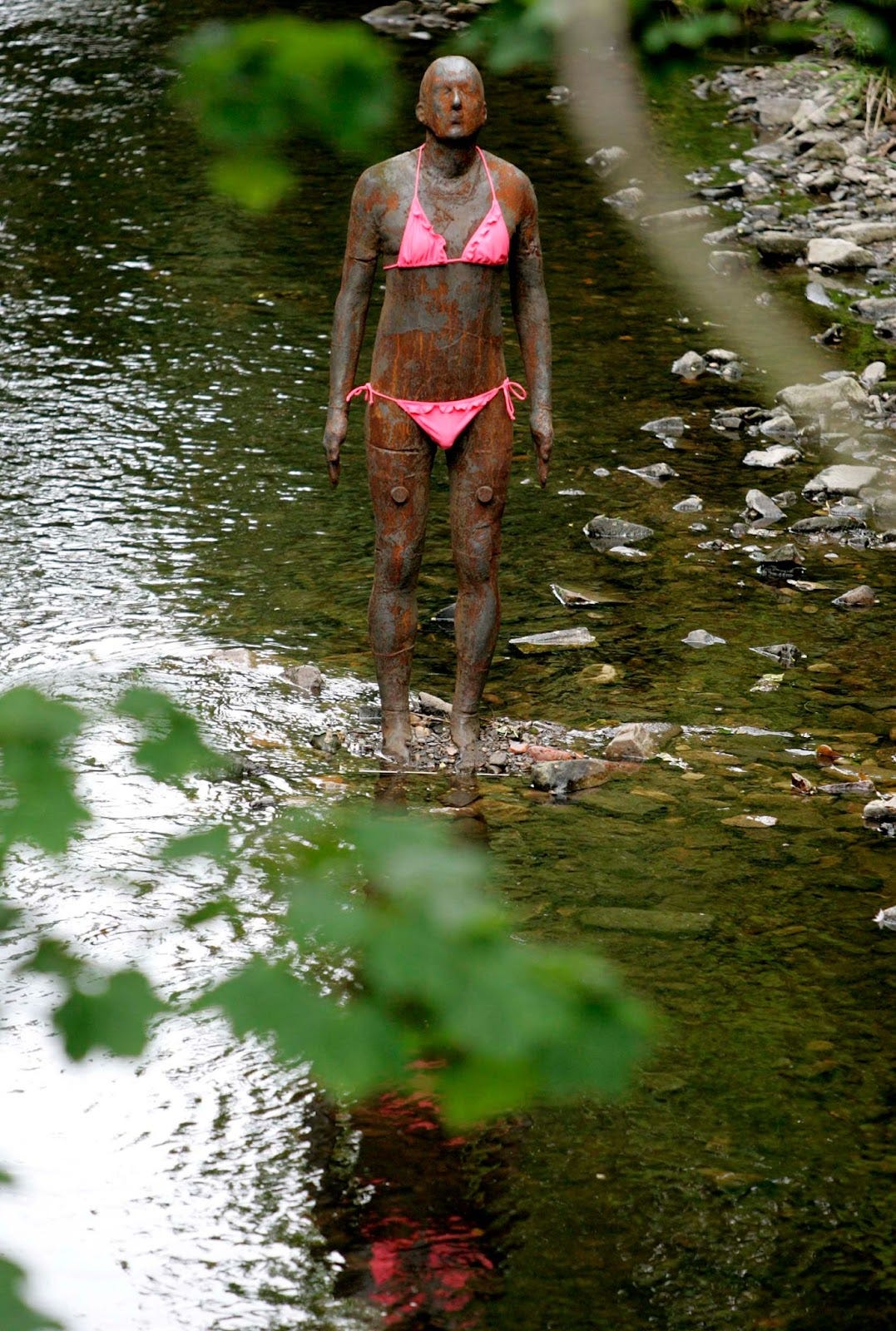
Yet living further down the Water of Leith and tending to walk upstream I experience this backwards. I am reminded of a famous scene in Kurt Vonnegut’s Slaughterhouse Five, where its protagonist Billy Pilgrim describes seeing war happen in reverse. The bombers hoover up the fires and destruction below them straight up into the sky, before landing backwards at home where their bombs are returned to factories in which teams of workers quickly disassemble them. In this sequence the Gormley’s resemble more the figures preserved in ash in Pompeii, each anonymised by the dirt, leaving only their final expression intact. The river path leading you backwards and closer to the source of the destruction. The closest of all with its body half submerged by layers of ash. The furthest caught just at its final moment of possible escape by sea. Since the statues have been in place, there have been countless reports of calls to emergency services, warning of someone having hung themselves in a tree by the river. Or in the process of drowning. The one closest to me in Bonnington is still eerie every time I catch it out of the corner of my eye passing by, especially as the sun sets, even though I know exactly what it is.
If this sounds like a dramatic response to a work of art that to many is a calming and tranquil addition to one of cities’ loveliest walks, then part of that is in how the Water of Leith acts as a vector for my personal climate anxiety. We live a few hundred metres from it and while sleeping my brain will automatically remix images of the water level rising in the different storms we had last year. On really bad nights the river will never stop getting higher, overrunning the sewer system that runs alongside it and sending an apocalyptic cascade through the area. When I am conscious I will zoom in on red and purple highlighted blobs on maps indicating exposed areas under various different climatic forecasts. Flicking through the pages of reports titled “Potentially Vulnerable Area 10/18”. The Scottish Environmental Protection Agency website allows you to track the water levels of each river in the country through the distancing visual language of a chart. There’s no use in me looking so regularly except to fuel anxiety, but I do it anyway.
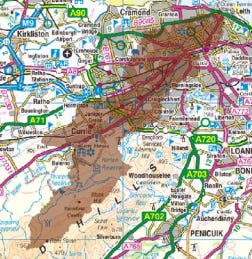
The Water of Leith isn’t a particularly dangerous river, in fact it’s very useful for mitigating the threat of flooding in the city. Anyway, I don’t even live near the most vulnerable parts of it according to the reports. The UK has a notably low exposure to extreme weather events, as last month's winter fires in Los Angeles help remind us. How ashamed would I feel explaining all this to someone at the sharp end of the climate crisis? I can’t remember precisely how much of Bangladesh is forecast to be underwater over the next few decades, but I know the consequences are not spread out evenly, regardless of how many celebrity millionaires just lost their mansions in Los Angeles. Given where I live I should probably be looking the other direction anyway, at the rising North Sea. Or perhaps, if I really care about imminent risks, just endeavour to focus more when crossing the road.
It could well be the presence of the Gormley’s themselves that have helped embed the river in my subconscious. In a discussion of his work at the LSE in 2007, the philosopher Renata Salecl describes her initial response to his figures as “anxiety, uneasiness” over “ some kind of a question that was posed to me as an observer” and praises them for “reintroducing anxiety as an essential human thing”. You do feel that in their presence. The Gormley’s seem to reverse the traditional sense of you looking at art and instead you feel like the statues in the water are almost demanding something of you. Asking you why exactly you are there and what is your purpose for looking at them so intensely. It’s unsettling.
Paradoxically, given their immense weight and the strength of the material, they are imbued with a sense of vulnerability. There’s the vulnerability of the process, in the saws cutting away next to the artists flesh, and of reproducing his own bareness all across the world. The casts leave visible marks of their own making in the discs, but also in small traces of the clingfilm and the cutting out of the moulds. Gormley once described a formative childhood experience of viewing a cast of William Blake’s head in the National Portrait Gallery in London, and feeling “the presence of someone through the skin” as if “something was trying to come through the surface”. He talked to Ernst Gombrich about his work “re-linking art with human survival” through the body. Yet all that’s left here is but a glimpse of a presence, found only in a preserved glance or the angle of an arm.
Their prominent position in the river is naturally vulnerable, whether to the Scottish sense of humour or the exposed elements. The sea gulls alone helping make each statue distinct. They were designed with hinges so that when the water levels reached a certain height they would fall forwards to let the torrent rush over them in safety. Learning this I think of the scene in The Pianist, where Adrien Brody’s character, a Polish-Jewish musician during the Second World War, observes a street full of dead bodies as a young man runs and collapses to the ground, pretending to be one of them to avoid the passing soldiers. The first falling forwards happened within a few weeks of their being put in place in 2010 after unusually heavy Summer rainfall, even for Scotland. Yet it revealed a mistake was made in the construction of the hinges, they didn’t spring back when the water pressure dropped. They instead just lay there submerged in the water, robbed of their power, waiting for the gallery staff to eventually come down and pick them back up. Never more like industrial fossils.
In 2012 the four Water of Leith statues were taken away during the construction of flood protection improvements to the river, and brought to Gormley’s studio with the hopes of fixing their broken hinges. In 2019 they returned with no hinging, now firmly secured, apparently, to the base of the river. Each time the water rises they take the immense power of the river in full, hoping to remain standing.