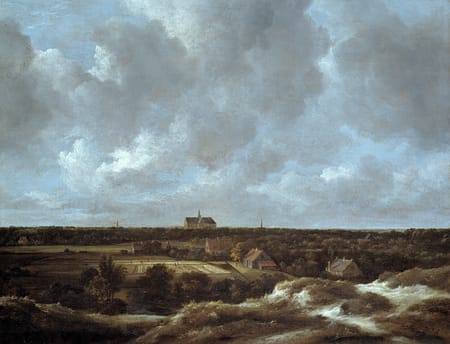
on saenredam and his interior of st bavo’s cathedral
Georges Perec’s essay “Species of Spaces”, he describes his efforts to imagine a completely useless space. A space without a single function at all. One that would “serve for nothing and relate to nothing”. But he can’t do it. Whatever he tries. He thinks of a manor house so large that he can’t keep track of the number of rooms in it. But every room he imagines has some use. He tries instead to bring things to mind that feel associated with this hypothetical void. A Borges story about unused staircases and ruined palaces. A dream of discovering a room in his own apartment he’d somehow always missed. And he thought about the work of a 17th century Dutch painter who dedicated his life to capturing church interiors by the name of Pieter Jansz Saenredam.
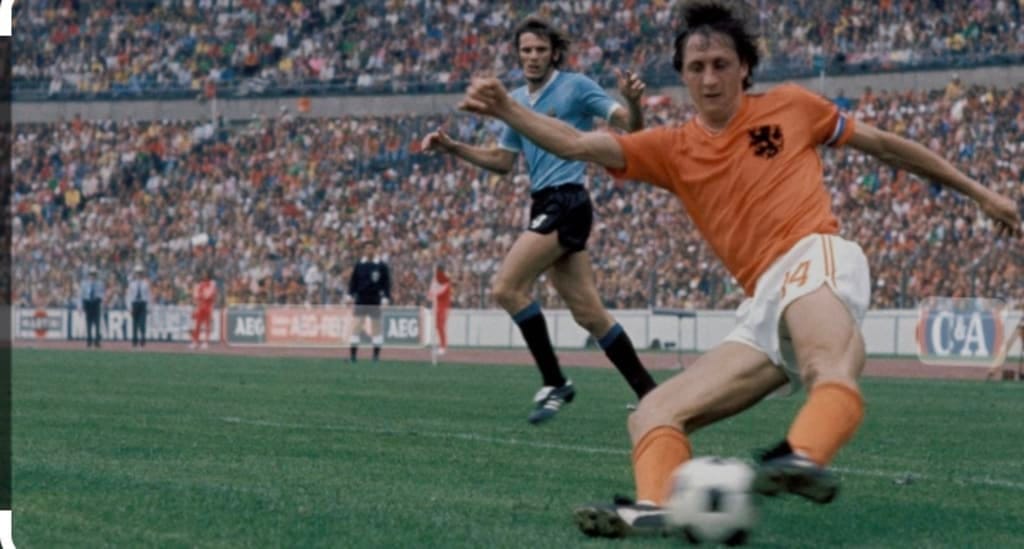
I first encountered Saenredam about a decade ago. I was on holiday by myself in Amsterdam and, lacking much to do in the evenings without company, would while away my time in a canal-side bar alternating reading with people watching. I had brought with me a history of Dutch football called Brilliant Orange - hoping this sort of comfortable soft cultural history would provide the perfect easy company for my inattentive holiday mind. In it we learn about “Total Football” - the enduringly named philosophy of the great 70s Ajax and later Netherlands National Coach, Rinus Michels, who saw positions as interchangeable, the individual as less important than the system, and the game as fundamentally about space. Then its author, David Winner, attempts the sort of audacious but fundamentally ridiculous comparison that I will always have time for. Leaping through fields and time, he argues that this same deep consideration of space and this sense of individual figures being eclipsed by the system is the legacy of a painter I had never heard of before, Saenredam.
Later that evening I would look up his work on the hotel Wi-Fi. Yet even primed by the book’s praise for him, on my tiny cracked phone screen they just looked like churches. I was at the Rijksmuseum a couple days earlier but must have walked past them totally unbothered. There were a lot of paintings of churches there. And I like churches. Fortunately I was planning to visit Den Haag the next day, and apparently they had a Saenredam. I would look properly then.
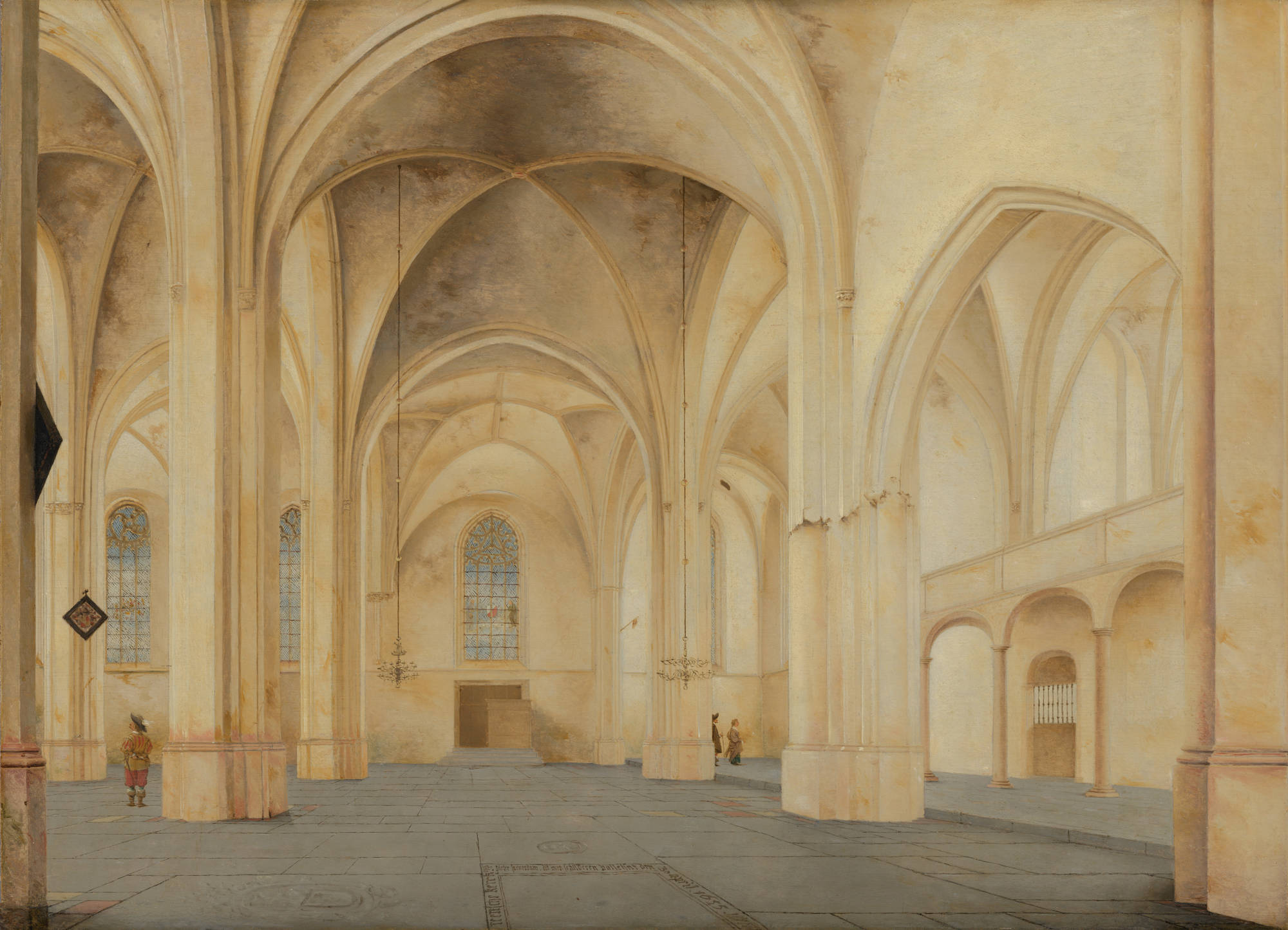
I met it unloved in the corner of a small room at the Mauritshuis. On the far wall of this room hung The Girl With the Pearl Earring, one of the few paintings so famous Hollywood produced a film bearing its name. Its stardom inevitably attracts a large scrum of people all jostling to get their own phone cameras into view. This spectacle made the immediate smallness of the Saenredam feel all the more disappointing. Winner had described his work as “visions of divine spatial harmony”, but where was it? Yet, reluctant to fight my way through the crowd to the Vermeers, I stayed in front of it a bit longer. There was certainly something soothing about the use of colour, almost transportative. The chaos on the other side of the room starting to fall away the longer I looked. Winner’s book had emphasized the precise measurements Saenredam had taken and I could start to see the geometric precision of the ribbed vaulting and a certain beauty that came from it. Akin, maybe, to the elegance of Pythagoras’s theorem or the intricate symmetrical structures observed in the natural world. Well that’s what I jotted down in my journal anyway, a young man desperate for dramatic insights to come pouring from my adult encounters with the western canon. Quietly terrified about what it would say about me if nothing would. I would later come to find that Saerendam was more slippery than that. He too had leaped through time, and he had tricked me.
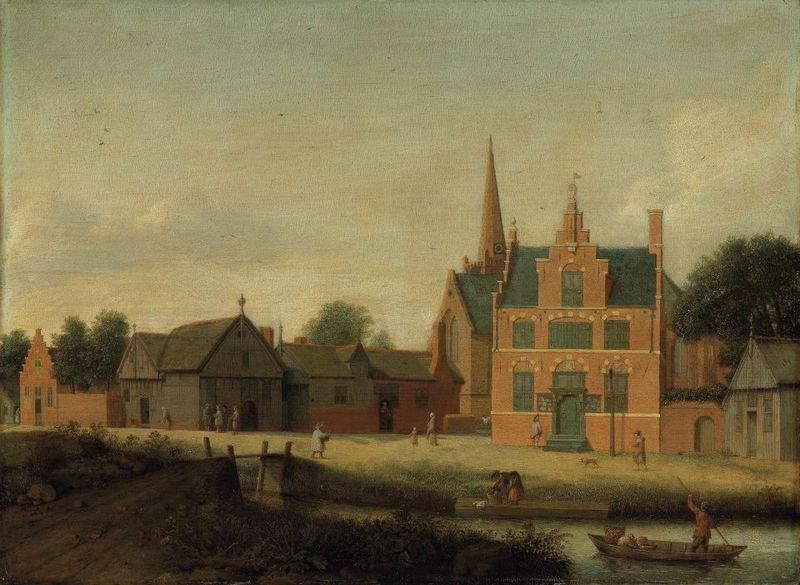
Pieter Jansz Saenredam was born in 1597 in Assendelft, a village eight miles north of Haarlem. He would, at thirty seven, return to his birthplace and paint his only known townscape scene. It is set looking back over the canal towards the courthouse, the spire of the 15th century St Odulphuskerk, rising behind it and to its left, the small house with the brick chimney in which he was born. The son of an engraver, at twenty he moved south to learn to draw and paint under the tutelage of Frans de Grebber, before becoming a free master in the Haarlem painters guild in 1623. Haarlem had been established as a centre for art over the previous century, but as the 17th century began was a town in flux. Destroyed by Philip II of Spain’s siege in 1573 compounded by a great fire in 1576, it had since transformed itself into a thriving centre for linen and brewing. Its economy enhanced by the offer of a three year tax waiver for Reformist weavers wishing to immigrate northwards from Spanish controlled Flanders. Accordingly its population doubled between 1580 and 1622 to 40,000.
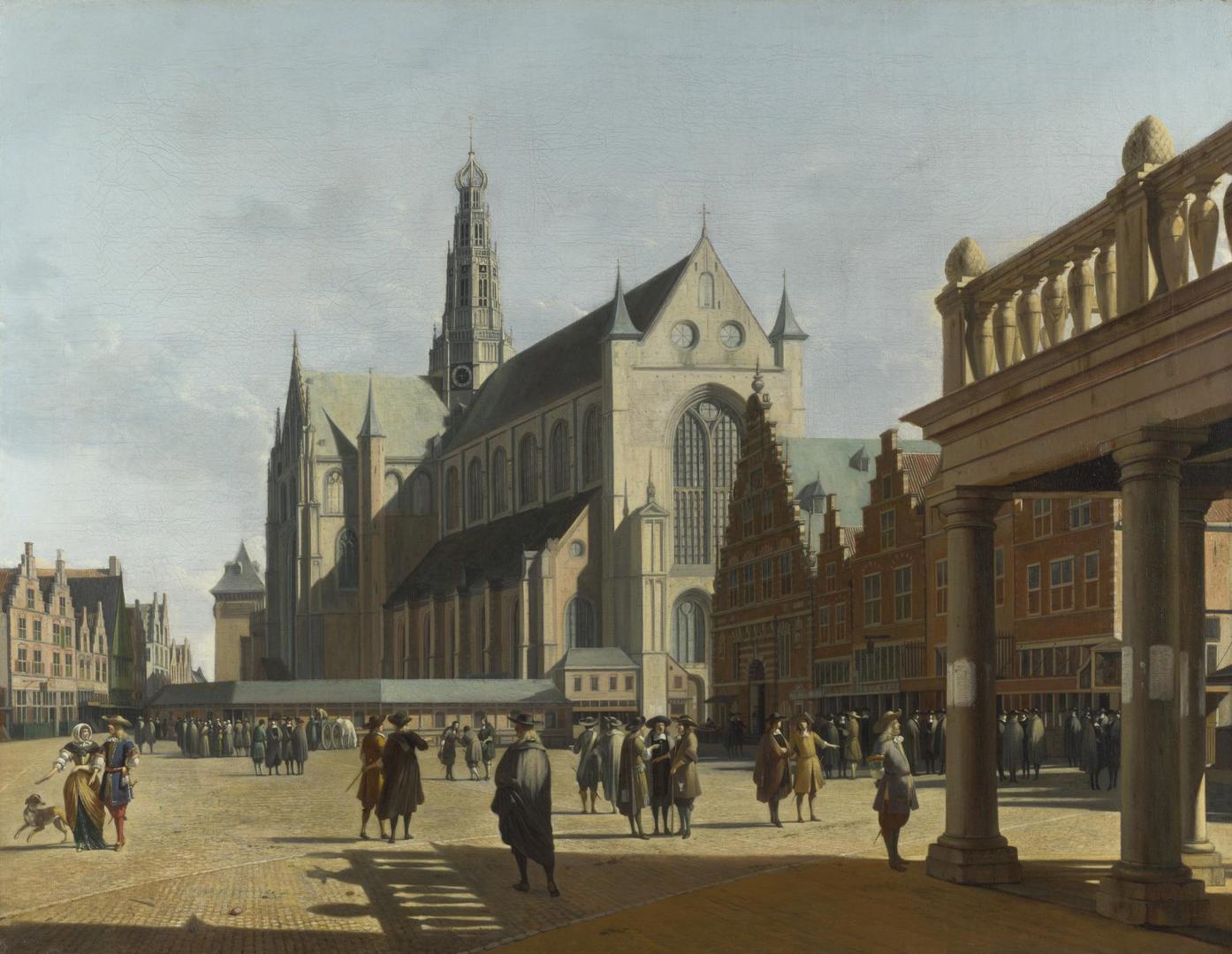
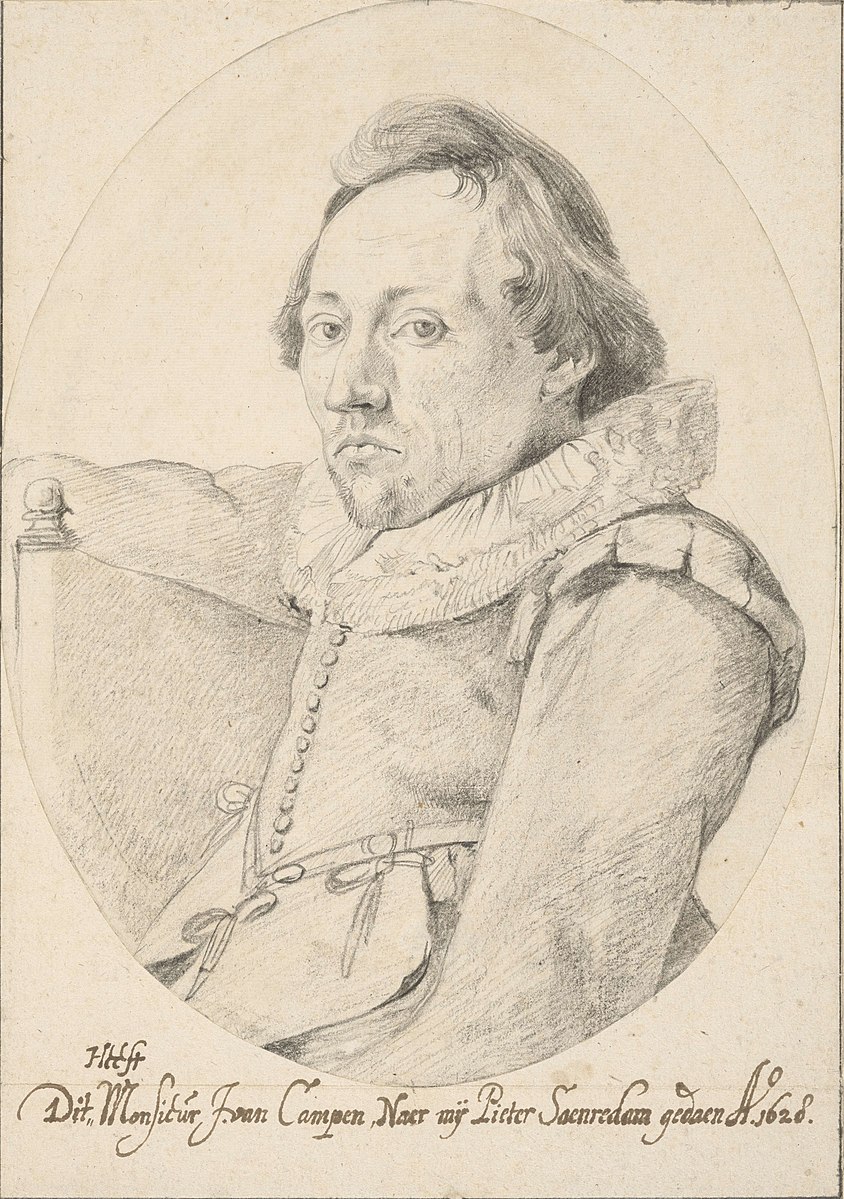
We know that Saerendum was active in its civic life - serving as dean of the painters guild and friends with many of its most influential citizens. He worked as an architectural draftsman in the 1620s for Jacob Van Campen, a pioneer in the geometrical style of classical architecture and responsible for Amsterdam's grand town hall. He was friends with Pieter Wils, an astronomer, mathematician and surveyor. His work would come to hang in the house of Constantijin Huygens, friend and patron, whose son Christiaan invented the pendulum clock, discovered Saturn’s largest moon Titan and formulated the wave theory of light. We have a record of a sale of his books upon his death in 1665 which shows him engaged with scientific and mathematical treatises. He was connected to the rest of the republic too, producing Church interiors in Alkmaar, Utrecht, ‘s-Hertogenbosch, Rhenen and back home in Assendelft. Working in competition with the thirteen rival painters of the same speciality. All the major towns in the republic were separated by just 45 miles and in 1631, Haarlem even had a horse barge service connecting commuters to Amsterdam. A city which would rise to prominence due to its maritime connections over Saenredam’s lifetime, while Haarlem would enter a period of relative decline after 1650. Yet he himself was insulated from this by the rising income emanating from his inherited shares in the Dutch East India Company. The ability for patient art historians to reconstruct estimated incomes from these does reveal how little we really know about him though. The reason for his decision in 1628 to dedicate his life to atmospheric church interiors? What motivated his distinctness from those before him? We can only guess.
In the decade subsequent to my first encounter in the Maruitshuis I would occasionally find myself in the company of a few of the different Saenredams that have been scattered across the world. Grateful to see someone who I had already imposed a stable interpretative framework onto and could feel a sense of certainty about. Maybe even commenting to the person accompanying me about his paintings were just empty churches, yes, but different. It’s about his mathematical calculation. How revelatory the truth could be. I was still living in fear of much of the art I saw, convinced that I was missing something obvious that was immediately clear to everyone else. That in expressing any emotional reaction I would immediately expose myself.
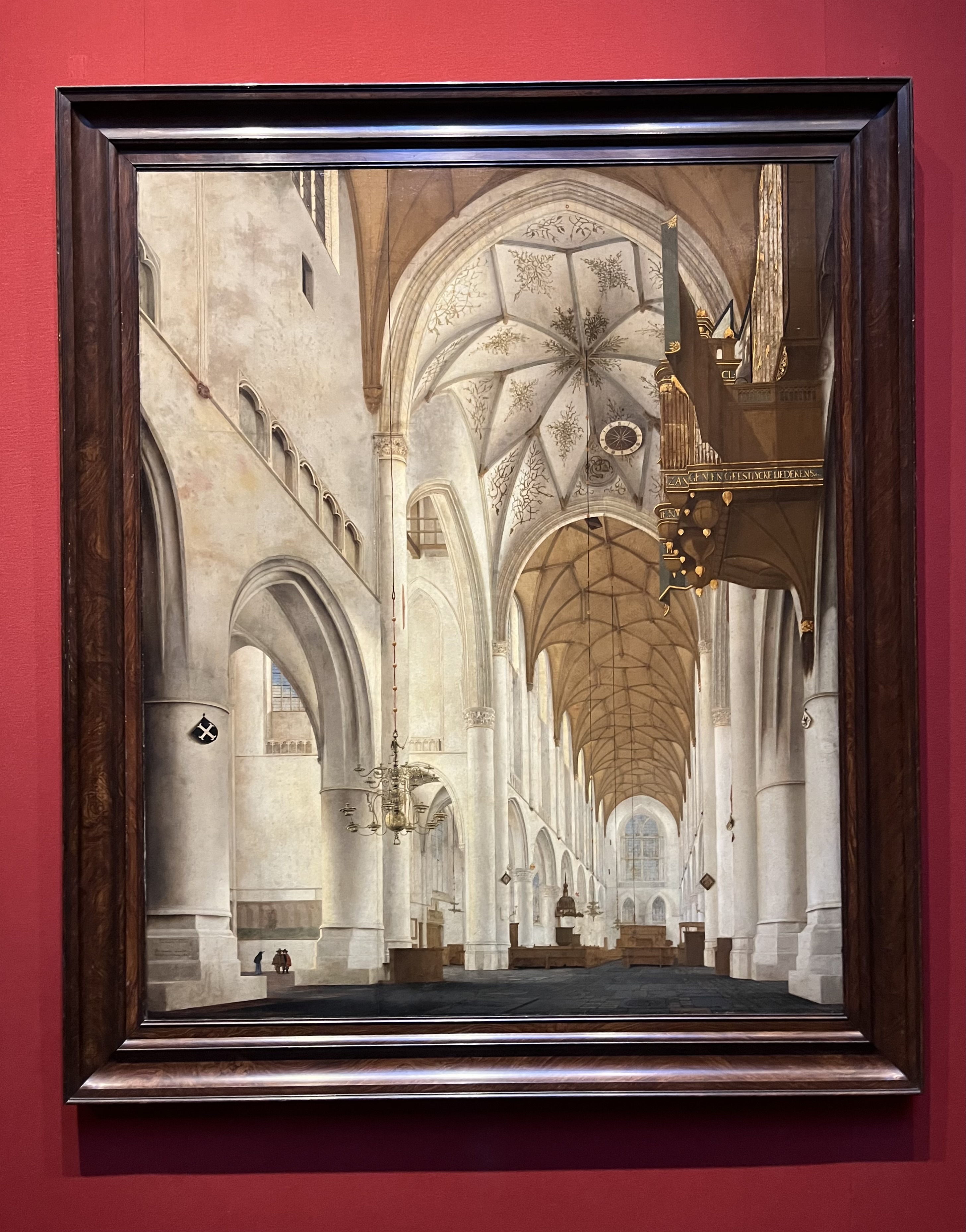
There’s one here in Edinburgh at the Scottish National Gallery, called The Interior of St Bavo’s (Grote Kirk). Unlike the first one I encountered, it’s physically substantial. Almost two metres tall. The largest surviving Saenredam in fact. The whitewashed church catches you from a distance next to the distinctive dark red walls and deep green carpets of the gallery, looking much the same as in its two Victorian era paintings of itself hung a few octagonal rooms away. The view is the one looking down the nave everyone wants to get on their camera. I was very glad to see it on my first visit, a nice part of a lovely collection, but didn’t give it much thought.
I visited the gallery again a few weeks ago with the aim of seeing the collection of Turner watercolours, that for preservation reasons are only exhibited for one month a year in January. A nice little cultural and civic ritual in the most miserable month of the year. Normally you can just walk in but this year they have swapped collections with the National Gallery of Ireland, and this has left the exhausted ushers politely suggesting to confused huddles of the elderly that, given the length of the queue, they might be better off returning at a different time. I instead decided to give the permanent collection another look, but my mind wasn’t really focused while winding round the Scottish gallery in the new underground extension and it was with an aggrieved sense of a wasted lunchtime that I eventually found myself back in front of St Bavo’s again.
As in Den Haag upon looking my mind was brought to ease. There’s something maddeningly reductive about the tendency I have just joined in with, to see art as a mental health tool - less a defensive posture in the face of the attention monopolising power of modern technology as a full on retreat, weapons all left lying on the battlefield. Yet the relaxing effect of this particular work is undeniable. There’s the colour tone, with its serene soft whites and browns, colours which Roland Barthes would compare to butterscotch ice cream. Saenredam was said to have had twenty shades of light brown on his palette alone and whereas his Church painting contemporaries would often favour dramatic colour contrasts, here there’s a tranquil elegance to how the colours blend into each other. Delicately capturing the way sunlight penetrates through the south transept window into the nave, despite the interior space already being flooded by it.
The lack of shadows should be eerie but somehow it isn’t. Perhaps because of the sense of harmony of the geometric precision, as if everything is exactly as it should be. There’s calm found in the vastness of the space depicted, the imposing whitewashed walls dwarfing the tiny figures in the corner and the austere pews. Dwarfing perhaps even the architectural features of the church itself, features that the painting is ostensibly concerned with documenting. As if the empty space contained within is the true subject of the painting. The German art critic Hans Jantzen thought so when, in 1909, he praised it as “the immediate experience of space risen to the highest plane”. As did Barthes in his otherwise scathing assessment when he said that “never has nothingness seemed so confident”. I could see too why his fellow Frenchman, Perec, associated it so deeply with absence.
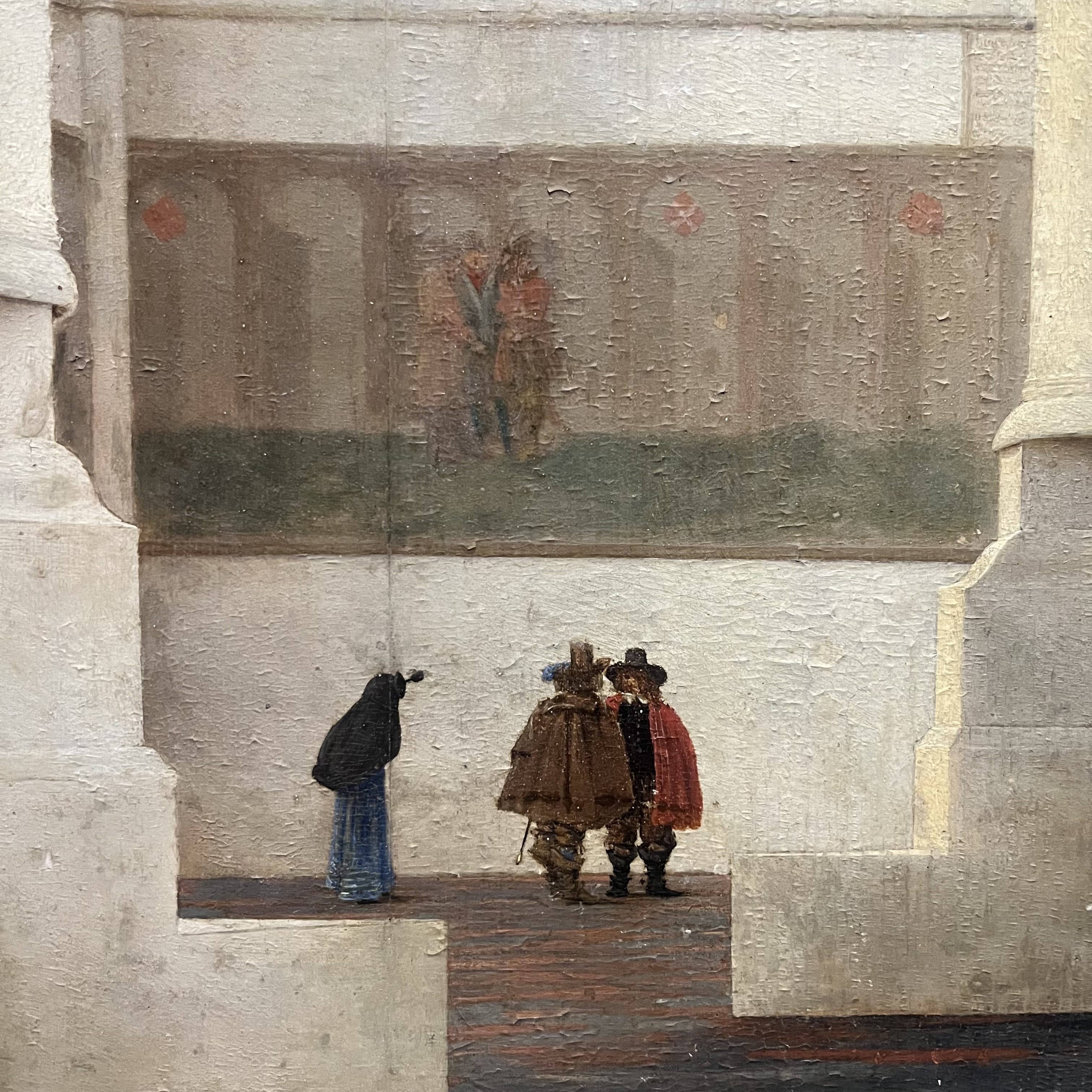
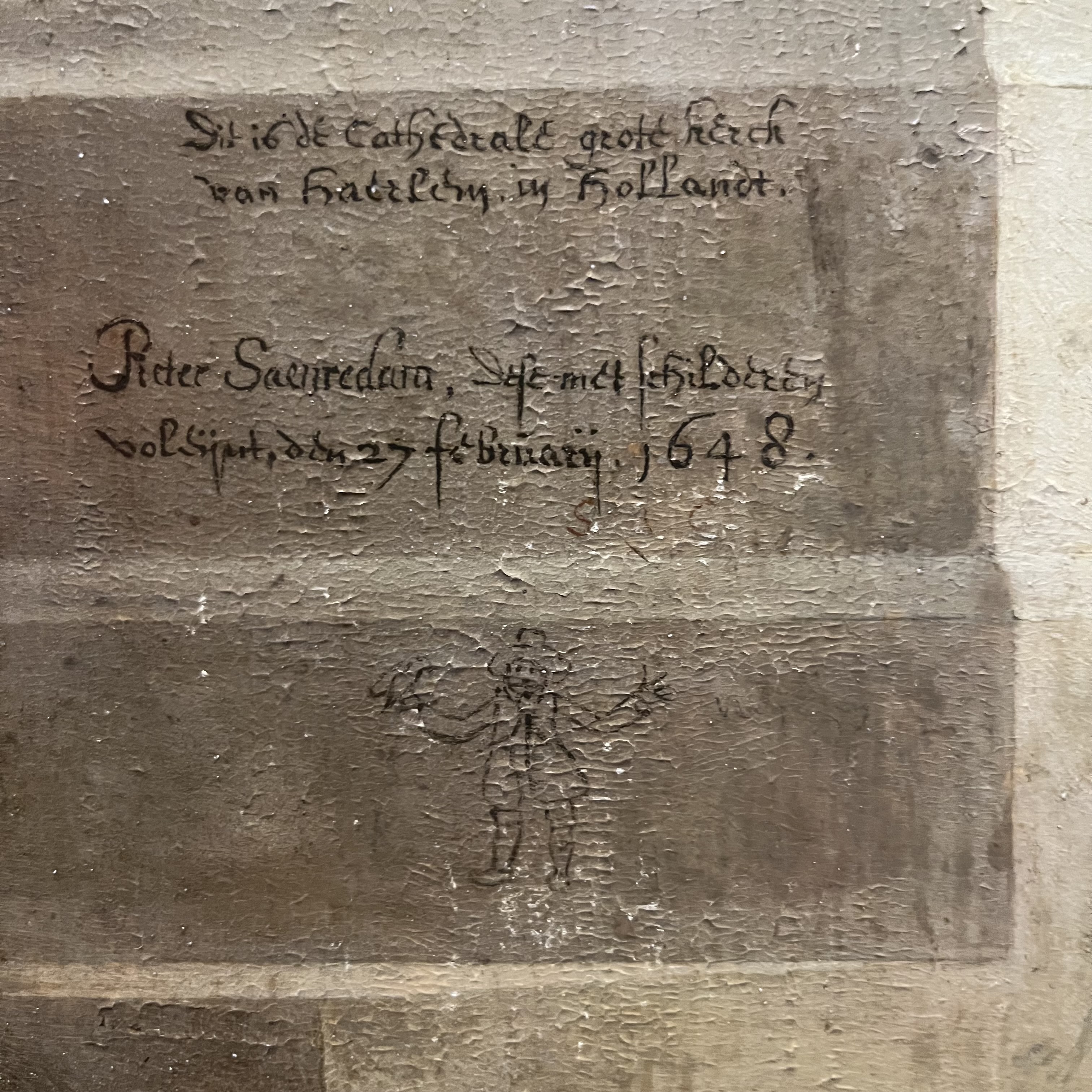
Arthur Kay, the Glaswegian son of a textile industrialist whose Saenredam now hangs in the London National Gallery, in 1899 said of his painting: “So lovely was the atmosphere of this little masterpiece that one felt inclined to walk up on tiptoes towards the distant window”. I felt that there in the Scottish National Gallery too, both in the sense of reverence and how the illusion of completeness on the flat canvas was so powerful it felt you ought to be able to lean in and get a better view. I was captivated. I got out my phone to take a photo of a couple of the details: the way he had included a cartoon drawing of a head next to his signature and a crowd of three tiny figures in the corner standing by a mural. It’s as if the woman in a shawl to their left is listening in to the two behatted men’s conversation while pretending to look at the mural. I tried to imagine this conversation and what the woman was thinking, maybe it could be a short story idea. But my knowledge of this time period let me down.
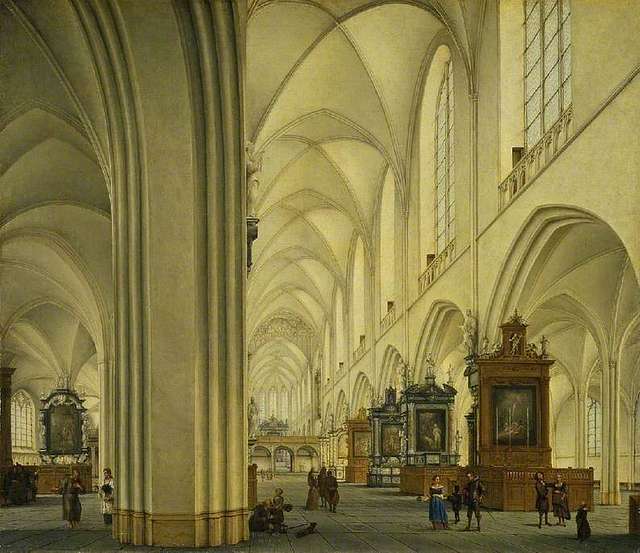
Feeling humiliated but unwilling to dedicate months of reading to be able to feel confident immersing myself in this world, I felt like I could at least find out what the mural was. I opened up Google maps to find the real St Bavo’s. Maybe it was still there. Flicking through photos visitors had shared online of the interior and finding nothing where I wanted it to be, I was struck mostly by how unmagical this place looked compared to the canvas. I realised next that Saenredam had painted multiple views of this same church over the years. I tried to see if there were other angles of my mural, creating a diagram of the view from each one to try and reconstruct the layout of the church. No luck. What about the thirteen other painters of church interiors in the Dutch republic? They must have captured it. They had the church, but none of them had my mural. Yet there was something clarifying in this failure, one of them by Isaac Van Nickelen in 1692 was a painting of St Bavo’s from the opposite direction to the Edinburgh one, directly inspired by Saerendam. You can see most of his techniques on show: A low, wide viewing angle, taken slightly off-centre, vast whitewashed walls, precise documentation of the space which is filled with light. It’s not the same though. There’s no magic.
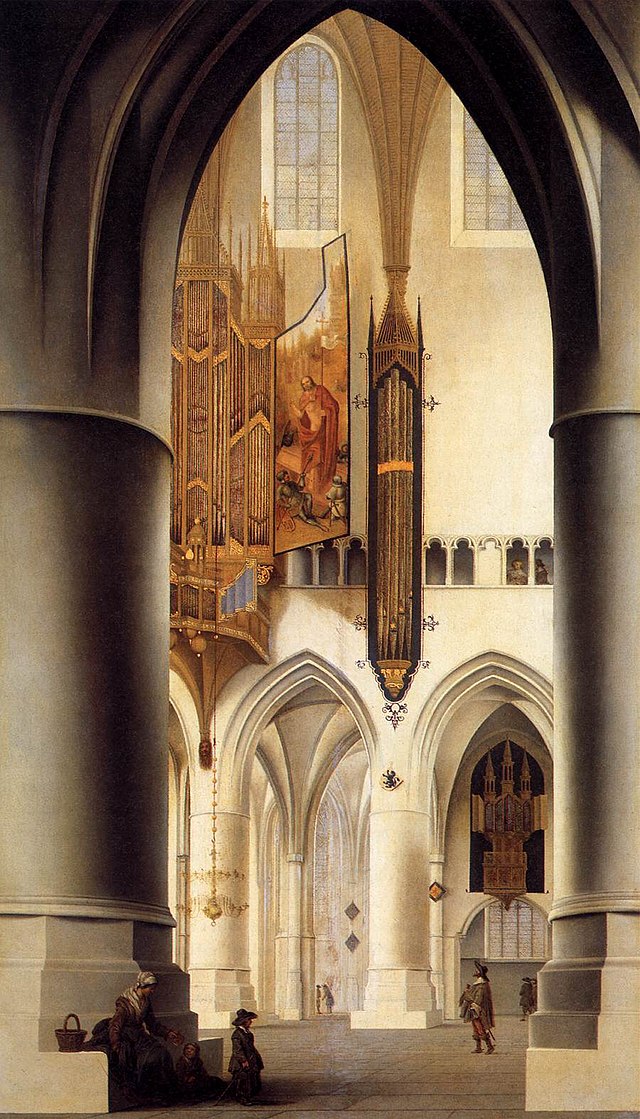
I did find out some things. The square hatchets perched on the columns which commemorated the recently deceased. A tetris block shaped painting, barely visible, above the doorway on the left depicting the church exterior, which apparently is now in the collection of the Haarlem Museum. The vast, imposing organ, on which quotes from Colossians Ch 3, Verse 16: “Teach and Admonish one another in psalms, hymns and spiritual songs”. A declaration that checks out, though apparently the Calvinists actually never used this organ in services and mainly wanted to demonstrate the technology that Haarlem’s new wealth could purchase. Another painting by Saenredum that I must have walked by in the Rijksmuseum all those years ago captures its beautifully decorated folding doors. Yet no mural. I reserved every book in the Edinburgh Central Arts and Design Library on Saenredam, and eventually one evening leaning over an old exhibition catalogue had to face the crushing sentence “The wall painting on the south aisle has not survived”.
Frustrated at my lack of a discovery that would vindicate my own interest, and left to explain to my wife why I had wasted days searching for a non-existent answer, I felt despondent. My searches had only really served to demystify that initial contact in a long sequence of dates, places, diagrams. Something essential was being lost.
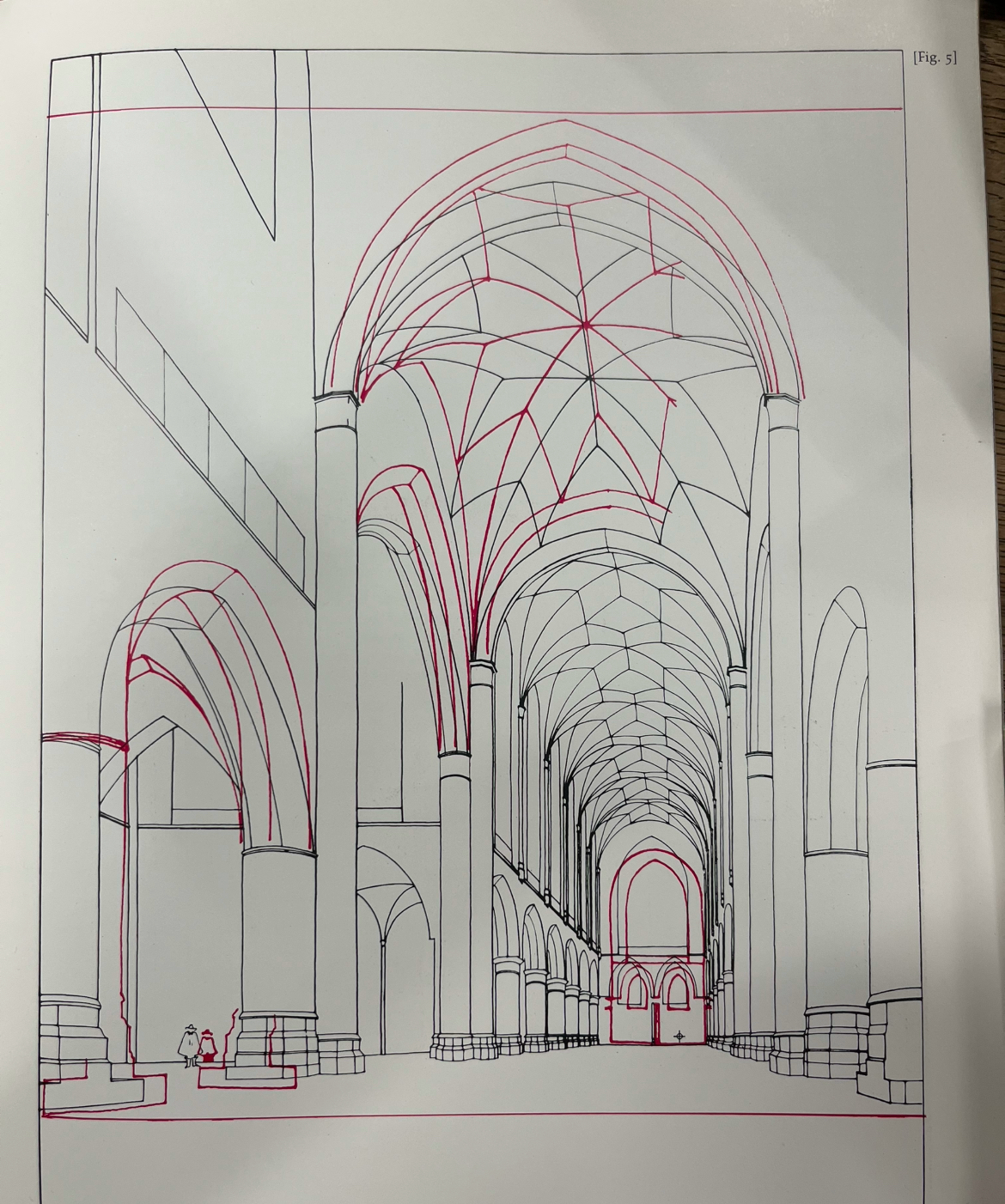
I was brought back by a series of explanations of his process that revealed exactly how Saenredam had tricked me a decade ago. It works as follows. Saenredam would make an initial free-hand sketch of the church from a seated position, normally low to capture the verticality and slightly off-centre so as to find an interesting perspective. He, or his mathematician friend Peter Wils, would then take precise and comprehensive measurements of the church. This knowledge would be transformed into a construction drawing, incorporating the precise measurements into a grid based system to make sure that the perspective is exactly right. As we have these drawings and the surviving church, we can see that the proportions for the back wall are so perfect that one supposes they must have been done by such precise measurement. In the St Bavo’s painting we are looking at today these were all completed between August and December 1635. Yet when it came to actually painting the work in 1648 we find a number of things have changed. The viewing angle is widened and brought back to integrate the Organ which dramatically accentuates the verticality, an organ which was in reality found on the opposite side anyway. The arches are now heightened and the nearest column widened to enhance this soaring effect. Instead of being a testament to the beauty of scientific precision, it is a work of artifice. A clever monument to how a church makes you feel rather than how it actually was.
The flipped organ then flipped something in me. There’s no mathematical solution here. I would instead get all this information back out of my head by writing this all down and I would go back to looking clearly again. Sveltana Alpers in The Art of Describing, argues that “the thrust of the professional study of Dutch art in our time has been to dig deeper than the naive museumgoer who exclaims at the sheen of Ter Borch’s satins, or the clear, calm air of a Saenredam church interior”, but when you are facing his work again it’s hard to really know why you would want to. What’s greater than this?