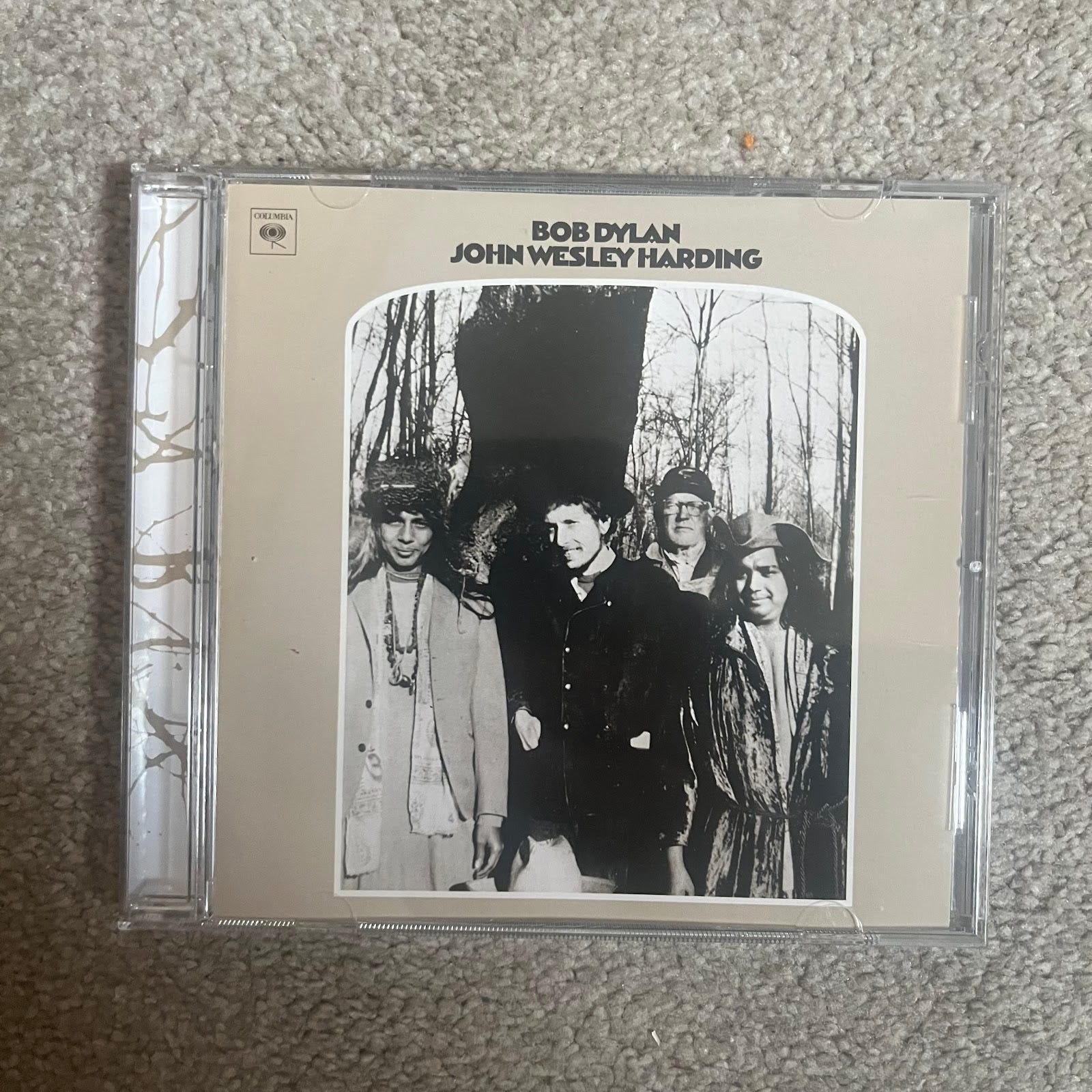
on john wesley harding, a 1967 album by the american singer-songwriter bob dylan
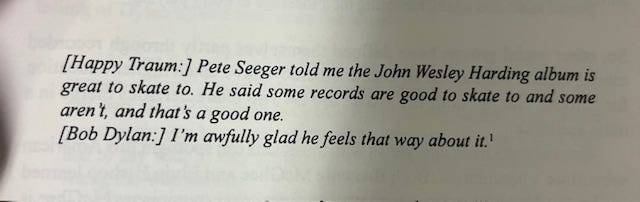
John Wesley Harding, the opening song of the album John Wesley Harding, starts with the line "John Wesley Harding". A repetition resembling big name fashion designers who try and fit their name as often as possible into one brand label. Dylan has never in decades of touring played the song live, whereas his website records him having performed the album's fourth track, All Along the Watchtower, a mere 2,300 times. In later interviews he would claim it became the title track as it's the only song on the album he didn't know the meaning of. Dismissing it as something that was done just to meet people's expectations of him as a poet. Yet with Dylan's interviews you tend to find the closer you pay attention to his claims about his own work the more lost you find yourself. In his infamously slippery world, the position of the song as a thesis statement for his eighth studio album is as straightforward a creative decision as you are ever likely to find.
Immediately the song establishes his shift away from the grandeur of Blonde on Blonde. His singing voice is gentle and almost serene, no longer straining for emotional resonance. The instrumentation has been paired down to Dylan on acoustic guitar and harmonica, backed up by a bassist and drummer. A soft rhythm is established as he moves through the opening verse. Gone is the surreal, kaleidoscopic imagery of his mid 60s work, instead the language is disarmingly simple, used to summon up old-world nostalgia for a heroic cowboy. Like many of the songs on the album it feels like it is presenting the opening verses of a much larger song that has been forgotten: its meaning lost to time. His harmonica interludes working harder than they had ever before, or would after, to suffuse emotion into the descriptive gaps. The astonishing outros to I am a Lonesome Hobo and I Pity the Poor Immigrant expressing what even a poet's words are incapable of.
These gaps have allowed some critics to see John Wesley Harding as a deliberately ironic statement. There's evidence for this, in the addition of a 'g' to the real figure's name, a person Dylan would clearly know was hardly the hero of legend. Looking at the specific phrases used reveals a surprising degree of ambiguity - the song's speaker repeatedly disavowing himself from the truth of the story by prefacing the reports of Harding's actions with phrases like: "They talk about", "Never known" and "Always known". It's clearly part of what makes it tick. Yet to allow this to fully account for the song, and then the album, as a Dylan biography I read earlier this year does, feels deeply wrong. There's so much genuine affection in there for a vision of an extinct America, for its old stories and traditions. The theme running throughout is hesitant, self-undermining and often incoherent, but that doesn't mean it's insincere. Perhaps I am as guilty as the people who see Dylan's genius as above such silly retrograde interests, deifying his steadfast refusal to give audiences what they want. I could instead be projecting my own favourite elements in art - elusiveness, multiplicity and a sense of internal conflict - onto something he had tossed off on a train to the studio and recorded over three hours to fulfil a contract.
An aspect which I feel supports my view, however, is the album's engagement with Christianity. Faith would later come to predominate his work, but in the 60s his writing had been thus far been restricted to occasional playful references. In John Wesley Harding however, a critic, Bert Cartwright, once counted sixty one individual scriptural references, an omnipresence that would help unify nearly all its songs. The product of a searching mind finding creative inspiration in the old book's diction and morality. His wife at the time, Sara Lownds, reported how frequently he reached for The Bible during the period of its conception. The album's third song, I Dreamed I Saw St Augustine, catches much of how his relationship with it differs from his later more explicitly religious works. A reworking of a 1930s proletarian song, now made to engage with the Christian philosopher instead of a labour activist called Joe Hill. It hits on familiar biblical themes in its treatment of a humble man trying desperately to save souls, travelling holding just a blanket under their arm, and with the "fiery breath" of hell lurking around him. Yet both the borrowed context of the dream and its conclusions rooted in the personal are far more open-ended than that. The song ends with the quietly devastating "So alone and terrified/I put my fingers against the glass/And bowed my head and cried". Words characteristic of an album that would be described by one, somewhat excitable, critic on its release as if "Jean-Paul Sartre were given a banjo and forced to describe all his theories in words of less than four letters".
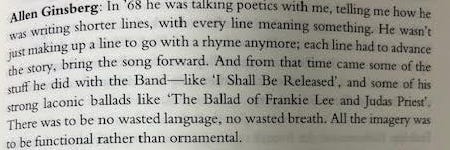
The album's longest song, The Ballad of Frankie Lee and Judas Priest, is perhaps the fullest encapsulation of the artistic conflicts underpinning it. It follows on from the foreboding, almost apocalyptic images that are left unresolved by the end of All Along the Watchtower, and by contrast the opening is almost unnaturally jaunty. Dylan taking particular relish in little internal lyrical repetitions - the enunciation of 'eternity' is especially pleasing - across its eleven verses. The song slowly narrates the story of two friends whose relationship spirals out of control after one of whom lends money to the other. It fuses resonances with 19th century American oral traditions and scriptural parables. Many of the images in it feel almost cliché: the stranger on the open road, the mysterious gambler, the house that's "not a house it's a home". Occasionally, however, an evocative line slips out. The "four and twenty windows/And a woman's face in every one", along with the ballad's violent, haunting resolution. Yet despite the straightforward simplicity of the telling, it doesn't make a lick of sense. In its final verse Dylan, the great non-explainer, starts explicitly laying out the moral of the story. A moral which seems to barely correspond to what has just taken place. As Judas Priest says in his final line in the song: "Nothing is revealed".
In this we get all of the album's distinct mixture of playfulness and sincerity, it's both a big joke and it isn't at all. A window into something lost but also something eternal. Perhaps the old-world values expressed in the supposed moral: of helping your neighbour and not deluding oneself into believing that the grass is greener on the other side are both absurd conclusions in the context of modern life yet also vital. Perhaps not. Anyway by the time Dylan had got to the album's final two songs, he'd already moved onto something else. Introducing a steel pedal guitar and adopting most of the country sound that would come to define his next run of albums. John Wesley Harding then leaves the listener, like in many of its songs, too soon for them to fully grasp its meaning. A strange but wonderful outlier, unelaborated on and unresolved. I can't get it out of my head.